For decades, law firms have relied on instinct: who is doing well, which client is important, where the next mandate will come from. While these decisions are often based on experience, they are frequently influenced by intuition, personal networks and fragmented information. This approach isn’t necessarily wrong, but it is incomplete. Today, law firms sit on unprecedented volumes of data, much of it remains unused or underutilized.
The firms getting ahead aren’t always the largest. They are the ones asking a crucial question: “What does our data tell us?” Therefore, the key issue is not which technology stack to adopt, but whether the firm has the clarity, discipline and operating model required to turn data into actionable decisions.
Unlocking the Hidden Power: From Information to Insight
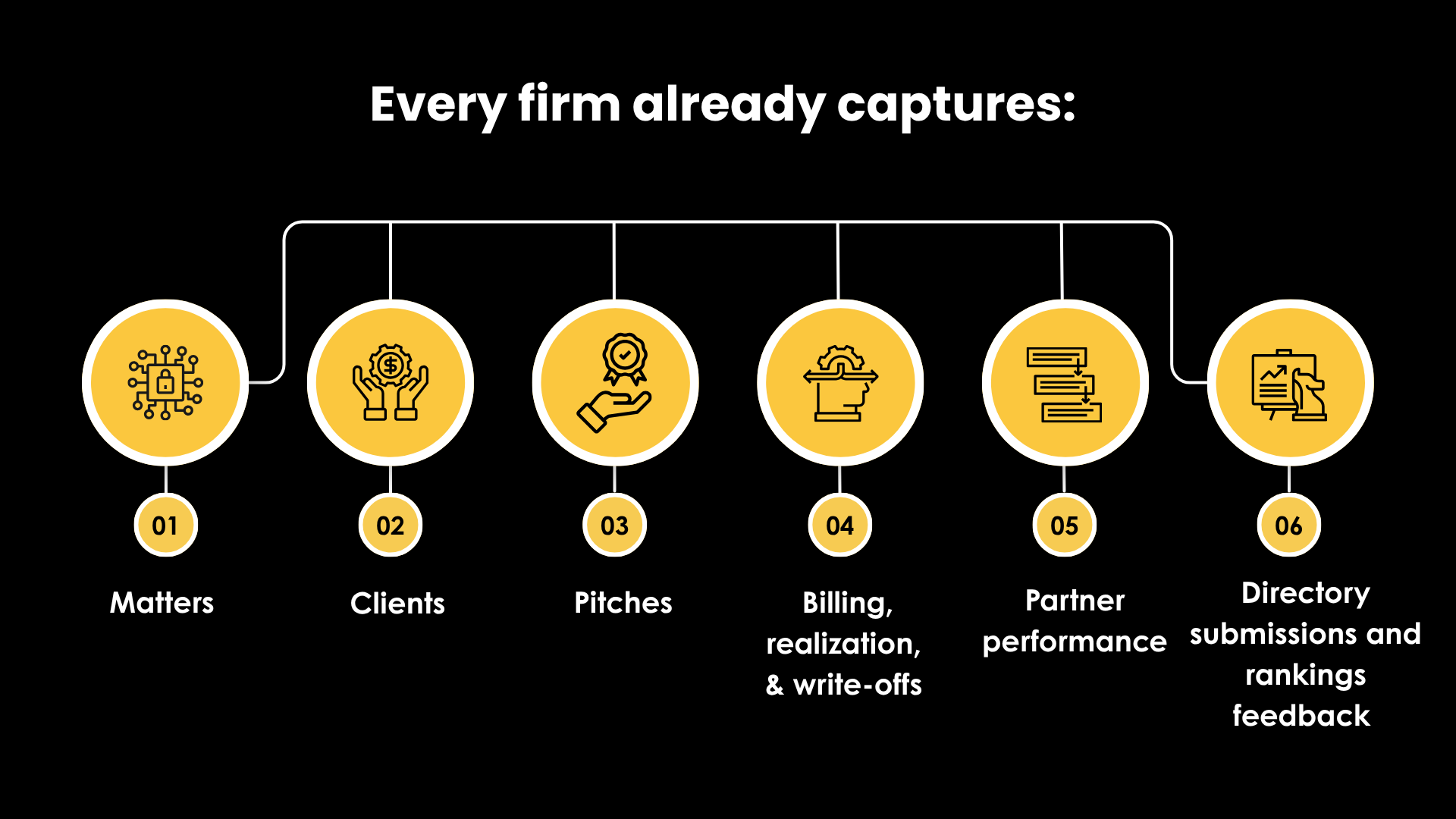
Viewed in isolation, these are operational metrics. However, when connected, they can serve as a strategic guide. Suddenly, answers emerge to the questions that fuel real growth:
- Where are we truly excelling?
- Which clients hold untapped potential?
- Which sectors are on the cusp of expansion?
- What patterns make work recur and why?
Data alone hints at possibilities. Insights emerge when data is connected, analyzed, contextualized and acted upon.
What Sets High-Growth Firms Apart
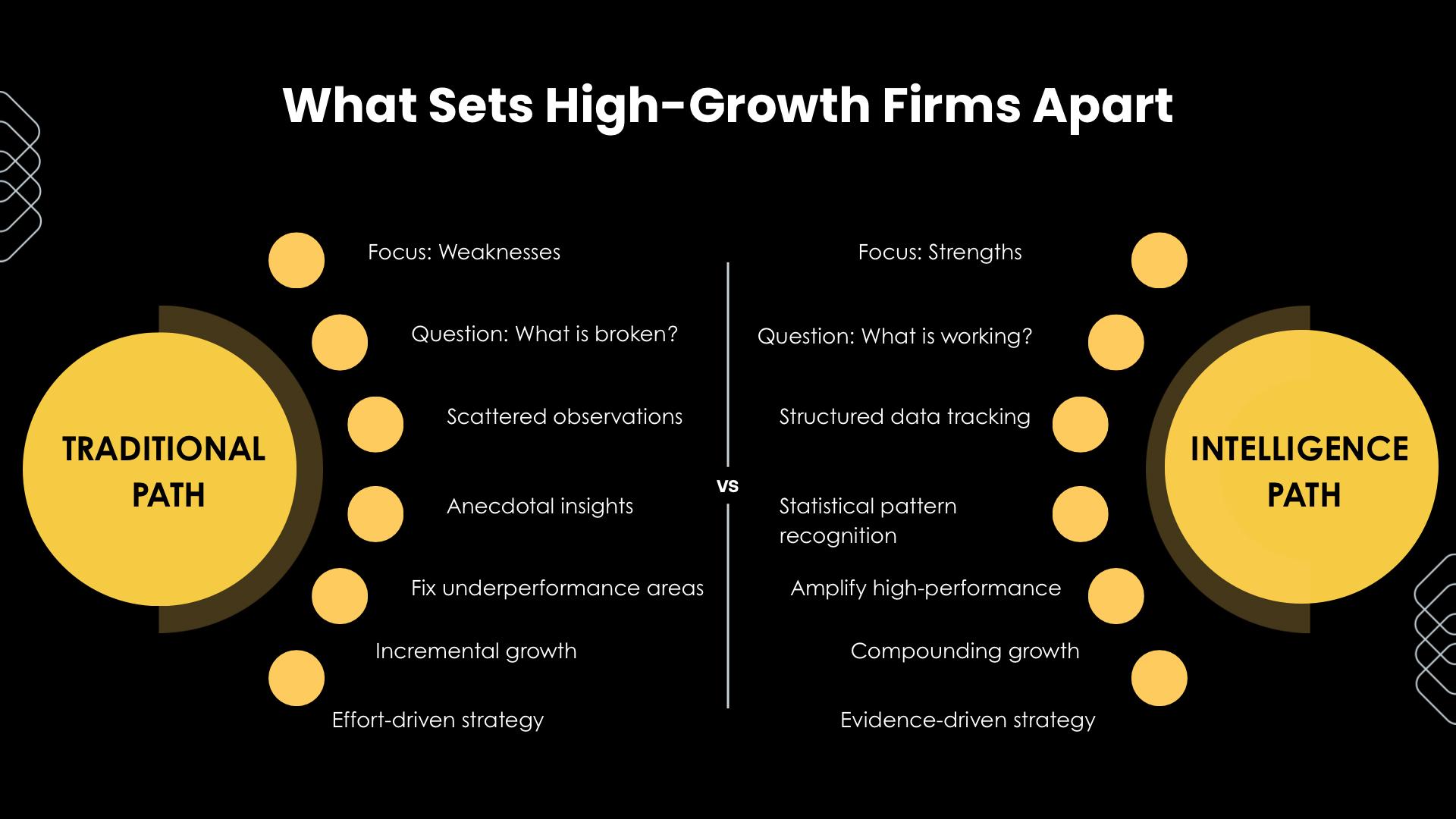
High-growth firms master five transformative shifts:
Shift 1: Tracing the True Sources of Work
Many firms believe they understand this aspect, but few actually track it effectively. Consider one firm’s eye-opening six-month audit: 50% of revenue traced to just five clients, routed through two key referrers. Until then, their BD efforts were spread across sectors, geographies and different events. They did three things once they saw the patterns:
- Deepened engagement with those clients
- Targeted positioning on those sectors
- Structured outreach to actively nurture those referral channels
In just two quarters, they saw notable changes:
- Repeat work increased
- Pitch dependency decreased
No fancy tools required, just honest tracking. Firms like Latham & Watkins exemplify this approach, using proprietary data and AI to excel in private equity and M&A by focusing on high-value opportunities.
Problem is not technology; it is disciplined tracking.
Shift 2: Understanding the 'Why' Behind Wins
While most firms track fees and timelines, very few understand why the client chose them and why they won the mandate. When that layer is added, patterns emerge quickly:
- Responsiveness beats pricing
- Relationships beat cold pitches
- Sector expertise drives repeat mandates
Firms like Seyfarth Shaw weaves this into their DNA, blending data science with workflows to dissect matter results, feedback, and efficiencies.
It’s not about inventing new strengths, it is about gaining clarity and scaling what is already working.
Shift 3: Turning Activity into Conversions
Once firms understand why they win, the next shift is operational: incorporating these insights into how pitches are crafted and presented.
One firm learnt something simple: pitches that included clearly relevant deal experience had twice the success rate. Their fix was elegantly simple – use of a central, searchable repository tagged by sector, role, practice, and size. Mandatory use for pitches slashed preparation time from days to minutes. Within one quarter, conversions improved measurably.
This mirrors firms like Baker Botts, which use CRM systems and analytics dashboards to track client engagement patterns and pitch effectiveness.
The shift is clear: From more pitches to data-informed pitches.
Shift 4: Elevating Directory Submissions to Intelligence
Submissions to Chambers, IFLR1000, Asialaw, Benchmark Litigation, or Legal 500? This is far more than branding exercises. These are actually structured market intelligence. Over years, they map:
- The evolution of your narrative
- Areas where you are gaining or losing traction
- Which matters truly set your firm apart
These submissions are repositories of your carefully curated deal descriptions and positioning narratives, client feedback, market perception and competitive positioning. However, many firms waste significant time and resources each year recreating this data from scratch. Firms that get this right do one thing differently: They maintain a live deal database.
That same data is reused across:
- Pitches
- Client meetings
- Cross-selling
- Internal strategy
Each matter becomes:
- A pitch asset
- A relationship tool
- A strategic signal
Increasingly, this is being enabled through more integrated approaches and platforms such as Mark My Matter, where matter data, submissions, and pitches are connected rather than siloed.
The shift: From static submissions to compounding intelligence
Shift 5: Identifying Patterns Early
Growth signals rarely appear as headlines. They show up as:
- A cluster of mandates in an emerging sector
- A client increasing engagement
- A partner consistently winning in a niche area
Firms that recognize these early signs can act quickly, positioning themselves ahead of the competition by enhancing their sector presence, targeting similar clients, and developing relevant pitch materials.
This is not prediction. It is pattern recognition done consistently.
Practical Steps to Ignite Change
You don’t need a complex system to start. Firms that see results begin with a few disciplined basics:
- A centralized matter tracker (client, sector, source)
- A centralized client tracker
- A pitch log (opportunity, outcome, reason)
- An updated searchable deal list
- Simple dashboards that provide answers to key questions, such as cross-sell signals
If maintained consistently, this becomes a usable dataset in weeks. Discipline forges value; technology merely amplifies it.
Data has evolved from support function to competitive advantage. The next growth phase for firms will hinge on precision: understanding where to focus, whom to engage, what to communicate and when to take action. Your firm already possesses the foundational elements for this. The real question is—will you leverage it effectively?
Authored by Shreya Sharma