Awareness as the first step
The legal industry is in the midst of a profound transformation, shaped by shifting client demands, pricing pressures, digital innovation, and globalisation of the service offerings.
In this changing landscape, a firm’s long-term success will depend on more than just legal expertise, it will rest on a less glamorous but far more essential foundation: disciplined processes.
For years, law firms have leaned on individual brilliance, highly skilled lawyers, strong client relationships, and a knack for delivering results despite inefficient internal systems. But that approach is no longer enough. The firms that will thrive going forward are those that operate like high-performance organizations, not just collections of talented individuals offering legal services.
With legal technology booming and firms investing heavily in new tools to improve workflows and outputs, it is easy to assume that simply buying the latest tech or updating software will solve the challenges.
The reality is different. The law firm of the future won’t be defined by tech savviness alone. It will be defined by its commitment to process and adherence to protocol.
By nature, law firms tend to operate with a free-flowing, individual-centric style. The individual often outweighs the organization, shaping how firms have thus far grown. But it is safe to say, that what got them here, will not take them to where they wish to be.
Why have law firms been incredibly late to the process party?
By design, law firms are not built for a mind that craves processes – for operational excellence.
Traditionally, lawyering is a noble profession. So being reactive instead of proactive is what comes to us naturally.
Partnership structure prioritizes autonomy over standardization
Built on a eat what you kill model, several law firms are functionally law firms, within law firms. Each partner or team runs their own ship – denying the systemic standardisation that corporate counterparts may enjoy.
Billable hours crowd out non-billable process discipline
Law firms resist anything that reduces individual autonomy without increasing individual benefit. Billable hours are the proof of the pudding, while non-billable processes become the inconvenient ingredient.
Incentives reward revenue, not behaviours
Historically law firm revenue models, are known to reward the highest revenue generators that add to the firm’s bottom line. Process etiquette on the other hand is a substantial part of “good to have” but not the a must have that results in direct revenue generation.
Highly individualized nature of legal work
Lawyers require to work in silos – taking on individual contributor roles, allowing for each one’s individual preferences and flare to become the very cornerstone of the processes they elect to follow.
Entrepreneurial culture resists operational discipline
Law firms are built by rainmakers and networkers. They are not built by what may appear as “donkey’s work” in terms of operational discipline.
Lack of visible short-term ROI
Unfortunately, processes are for those who play the long term game. To anyone focusing on the now and the current, will question the labour that goes into creating, adopting and retaining processes.
No clear process ownership
The real struggle for law firms, is not creating world-class processes. It is the adoption of the very processes. The gap, is often indicative of behavioural change challenges.
Why processes matter for the law firm of the future?
The future cannot rely on the sporadic adoption of processes. To elevate the quality of service, law firms must begin the deliberate consolidation of their internal workflows and cultivate more robust channels of communication.
Your service delivery must present as a unified, seamless offering. Today’s general counsel is far more discerning than their counterpart a decade ago.
Clients now demand a global level of experience, even from firms operating domestically. It is therefore imperative to prepare for scalable growth and foster deeper internal collaboration.
Ways to adopt and retain processes
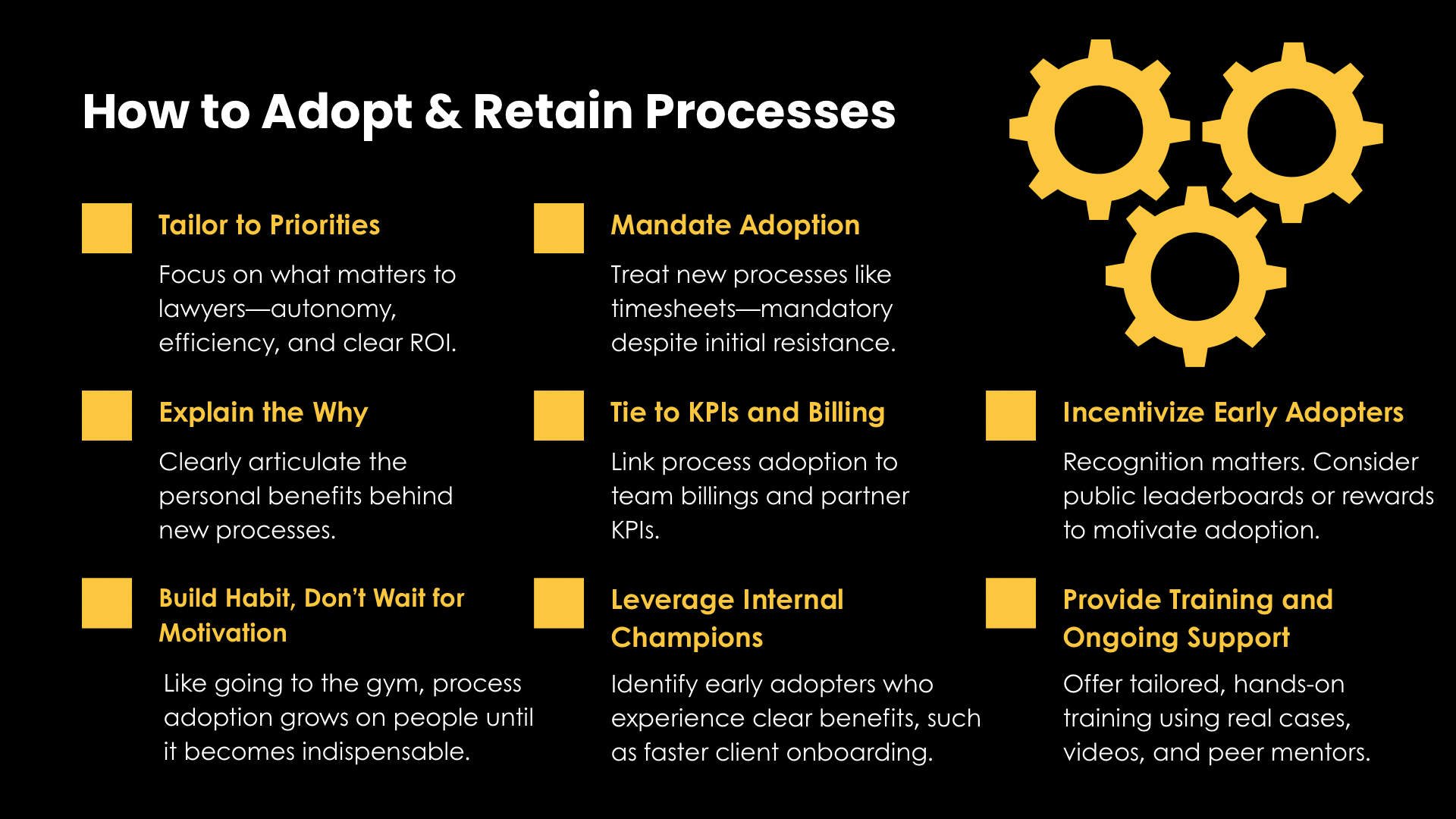
What we are primarily aiming to change is – behaviours. And behaviours change when you explain why change is not an option but a necessity. We resist change when we do not see the urgency and the best way to explain this is to show your firm what is not working and connect it to personal impact. Something like, we are missing opportunities, which then means lesser monetary and opportunity growth for you.
- Tailor to Priorities: Focus on what matters to lawyers, autonomy, efficiency, and clear ROI. Craft strategies that resonate with these priorities by leveraging effective communication, quick wins, and incentives proven in legal change management.
- Explain the Why: Lawyers are smart and understand the value of efficiency and billing impact. Clearly articulate the personal benefits behind new processes. When you reframe the narrative and explain the rationale, buy-in happens faster.
- Build Habit, Don’t Wait for Motivation: Like going to the gym, process adoption grows on people until it becomes indispensable. Don’t rely solely on motivation; embed the habit.
- Mandate Adoption: Treat new processes like timesheets, mandatory despite initial resistance. If lawyers comply with timesheet rules, they can adopt other mandated processes for the firm’s greater good.
- Tie to KPIs and Billing: Link process adoption to team billings and partner KPIs. When the impact is measurable and tied to performance metrics, it encourages uptake and lets the benefits cascade upward.
- Leverage Internal Champions: Identify early adopters who experience clear benefits, such as faster client onboarding. Empower them to advocate firm-wide through demos and testimonials. Start with pilot projects in specific practice areas to showcase tangible results (e.g., 20-30% time savings), building momentum before full implementation.
- Incentivize Early Adopters: Recognition matters. Consider public leader boards or rewards like movie tickets, holidays, or tech gadgets (iPhones, iPads) to motivate adoption.
- Provide Training and Ongoing Support: Offer tailored, hands-on training using real cases, videos, and peer mentors to suit diverse learning styles and reduce intimidation. Maintain accessible resources like quick-reference guides and helpdesks for immediate support. Some firms go further by deploying process adoption teams that coach lawyers personally through new workflows.
In Conclusion
Law firms that fail to wake up and recognize the shifting realities of the industry will soon find themselves grappling with avoidable inefficiencies, weakened revenue streams, and stalled growth.
Future readiness is no longer defined solely by the ability to bring in new clients or generate fresh work. Instead, it hinges on the strength of a firm’s internal infrastructure, its systems, processes, and the cohesive execution that ties everything together. Sustainable success demands integrated, well designed operational frameworks that support the very work being won, ensuring consistency, quality, and scalability.
The Grey Matter collaborates with law firms across different sizes to design tailored processes for specific issues and supports lawyers through hand-held implementation and adoption.
Authored by Tanisha Deshpande